A Kenya safari costs roughly $250 to $2,000 per person per day, depending on comfort, season and how you travel. Here's where the money really goes, what the 2026 park fees are, and how to get the best safari for your budget.
You'll find Kenya safaris advertised for a few hundred dollars and for many thousands, and from a distance the difference is hard to see. We want to show you what goes into the price, so you can judge any quote, including ours, and spend in the places that make a real difference to your trip.
The cost per day, by comfort level
Value is not 'basic'. In Kenya it usually means clean, comfortable lodges or permanent tented camps with en-suite bathrooms, full board, and the same parks and game drives. Mid-range gets you better locations, often inside or right on the edge of the reserve, so you spend less time driving and more time watching. Luxury means small camps in private conservancies, exceptional food, off-road driving, night drives and walking safaris.
Where your money actually goes
Every safari price is built from the same three blocks. Here's a typical 6-day, mid-range safari for two people travelling in peak season.
1. Accommodation
This is the biggest part of any safari budget, and it's where the range is widest. Full-board lodging in Kenya runs from about $100 to over $1,500 per person per night. Position matters as much as luxury. A simple camp inside the reserve can be a better buy than a grand lodge an hour outside it, because you save two hours of driving every day.
2. Vehicle, fuel and your guide
A private 4x4 safari vehicle with a professional driver-guide and fuel typically costs $180–$320 per day, shared between everyone on board. This is why the price per person falls so sharply for families and small groups: four people sharing a vehicle each pay a quarter of what a solo traveller pays.
3. Park and reserve fees
Fees go straight to the park authorities and fund conservation, rangers and local communities. They rose in Kenya in October 2025, and they're per person, per day.
Work out your own budget
Move the sliders to see what a safari like yours might cost.
A planning estimate from typical 2026 market rates, not a quote. International flights, the Kenya eTA, insurance and tips are extra. See our fixed-price trips or ask for an exact quote.
Costs that sit outside the safari price
Nairobi's Jomo Kenyatta International Airport (NBO) has non-stop flights from New York, London, Amsterdam, Paris, Dubai, Doha, Istanbul and many Asian hubs. Kenya Airways flies non-stop from New York JFK every day.
Every visitor needs an Electronic Travel Authorisation, applied for online before travel. Since October 2026 you also need to show travel health insurance that meets Kenya's minimum standard. See our entry requirements guide.
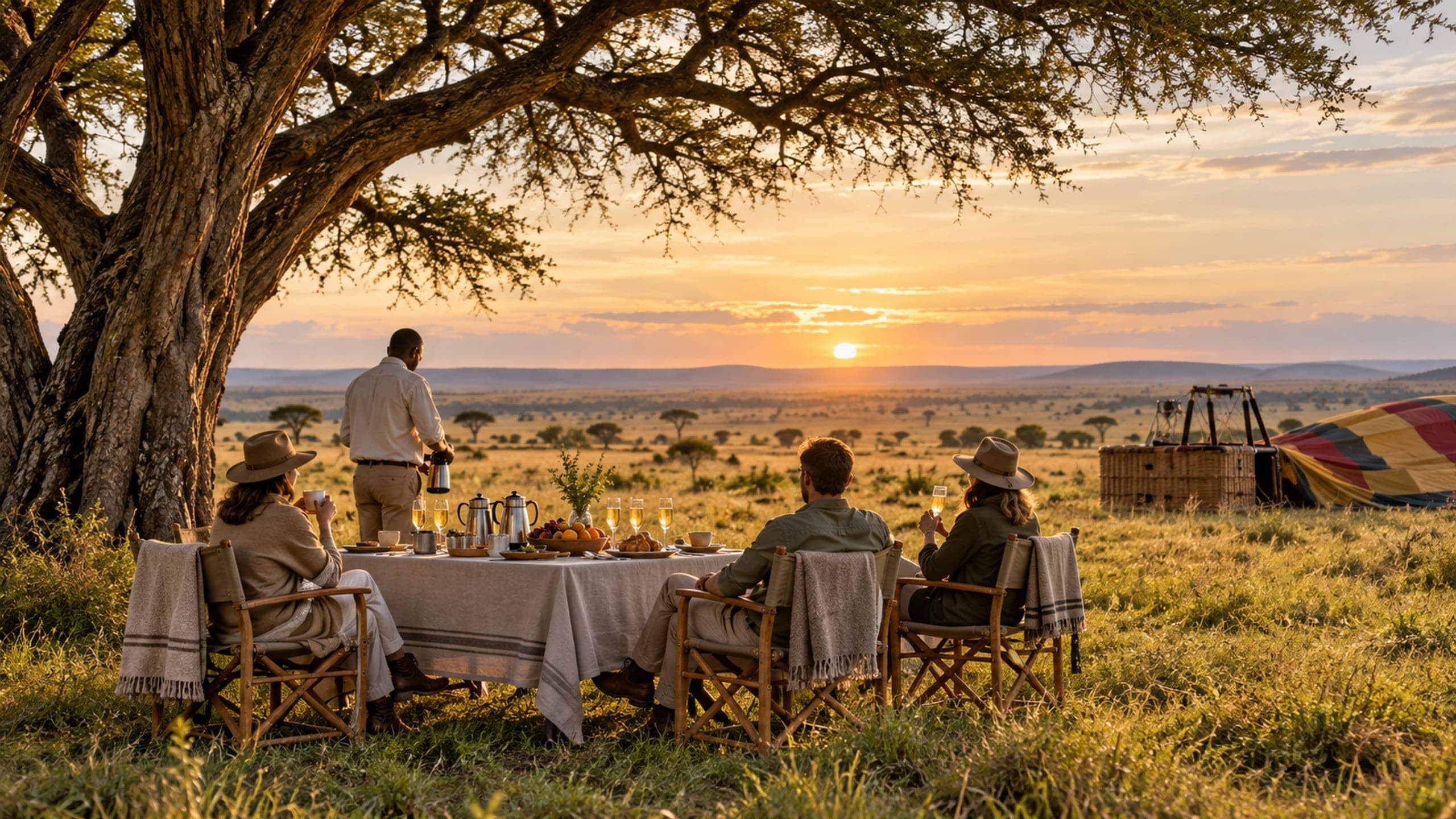
A sunrise balloon flight over the Mara with a champagne bush breakfast. It's optional, unforgettable, and it books out in peak season.
Gratuities for your guide and camp staff are customary. Our tipping guide has a calculator for your exact trip.
Flying from Nairobi's Wilson Airport to the Mara or Samburu saves 5–6 hours on the road each way. Bags are limited to 15 kg in soft luggage.
Premium drinks, laundry at some camps, and optional cultural visits. Many luxury camps include house drinks and laundry.
Seven honest ways to make your budget go further
- 1Travel between January and June
The Maasai Mara fee is $100 instead of $200, and lodge rates drop. On a four-night Mara stay, that's $400 per person saved on fees alone.
- 2Fill the vehicle
Travelling as a family or with friends? Sharing a private vehicle between four people brings the per-person cost down sharply, and you still have your own guide.
- 3See fewer parks, stay longer
Every park change costs a half-day of driving. A 6-day trip in two parks often shows you more than the same trip spread across four.
- 4Drive one way, fly the other
Drive out through the Great Rift Valley for the views, then fly back to Nairobi. You get a scenic day and save a long return drive.
- 5Mix your lodging
Spend on the camp that matters most, usually in the Mara, and pick comfortable value lodges for the transit nights.
- 6Book peak season early
Early bookings get the best-placed camps at the published rates, before the remaining rooms go to last-minute demand.
- 7Ask what's included
Park fees, drinks, airport transfers, the balloon, the guide's lodging. A cheap quote that leaves out park fees isn't cheap at all.
What Creeks safaris cost
Our published trips show the price up front. Here are a few examples across a range of budgets, all including your vehicle, driver-guide and accommodation as described on each trip page.
Frequently asked questions
How much does a 7-day Kenya safari cost?
A 7-day Kenya safari typically costs $2,000 to $3,500 per person at value to mid-range level, sharing a room and a vehicle, and $7,000 or more at luxury camps. Season, group size and whether you fly or drive between parks all affect the price.
Are park fees included in a Kenya safari price?
With a reputable operator they should be. Always check. Park fees are significant in 2026: $200 per adult per day in the Maasai Mara from July to December, $100 from January to June, and $90 per day in Amboseli and Lake Nakuru.
What is the cheapest time for a safari in Kenya?
April, May and early June are the cheapest months, followed by November. Lodges offer green-season rates and the Maasai Mara reserve fee is $100 per adult per day until 30 June, half the second-half rate.
Is a Kenya safari cheaper than a Tanzania safari?
Often, yes. Kenya's main parks are close together and reachable by road from Nairobi, which saves on internal flights. In the Serengeti, Tanzania also charges a nightly concession fee on top of park entry. For a comparable mid-range itinerary, Kenya usually works out a little cheaper, especially from January to June.
Do children pay less on safari?
Yes. Park fees are lower for children: $45 per day at Amboseli and Lake Nakuru, and $50 in the Maasai Mara for ages 9 to 17, with younger children entering the Mara free. Many lodges also offer child rates when children share with their parents.